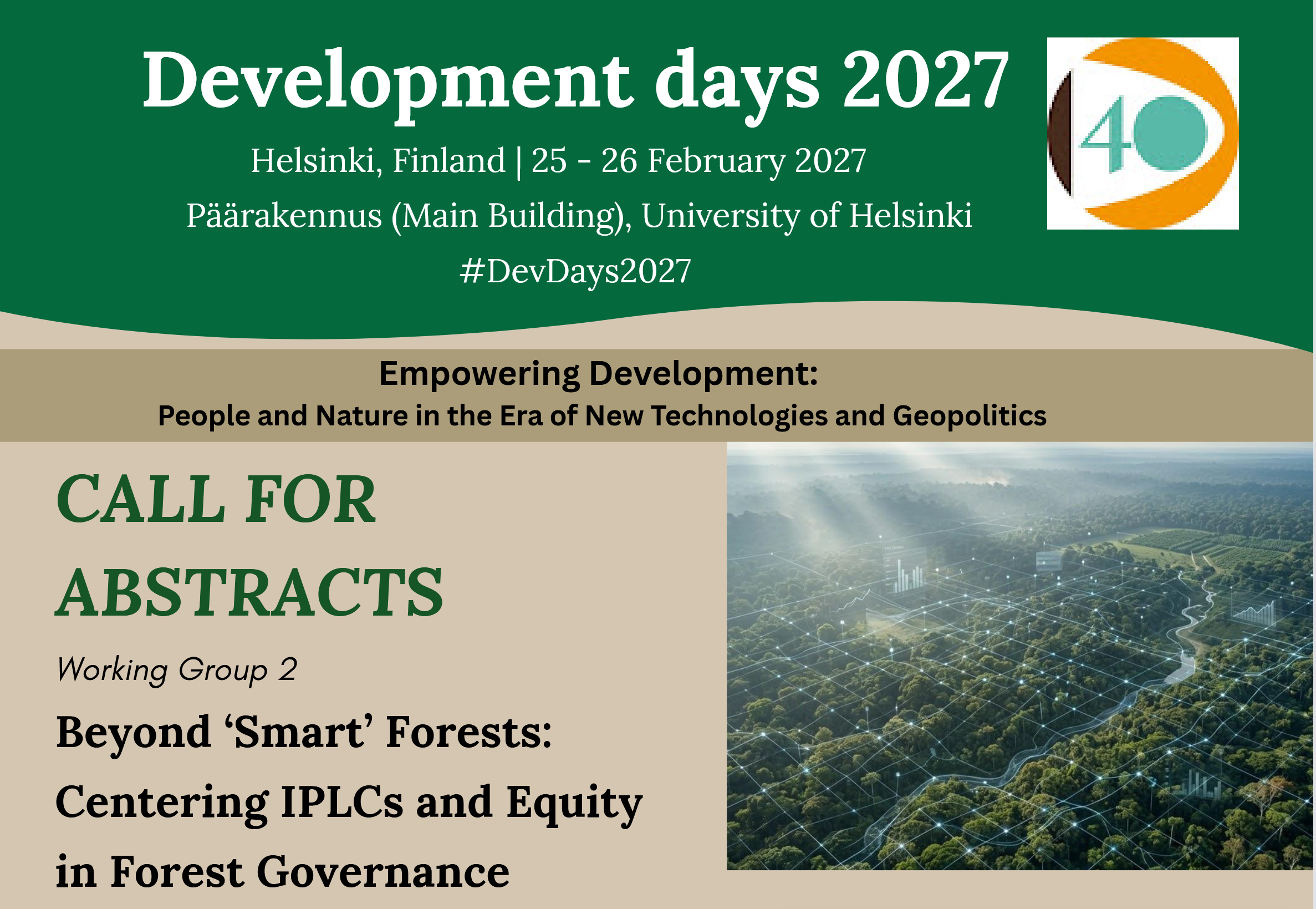
Beyond “Smart” Forests: Centering IPLCs and Equity in Forest Governance
We are glad to invite submissions to our planned session (In-Person Only) that will be held onsite at the Development Days Conference, 25–26 February 2027 at the Päärakennus (Main Building) of the University of Helsinki, Finland. Abstracts (max. 300 words) should be sent to akonwi.ayonghe@helsinki.fi by deadline 25 November 2026. Please note that our Working Group is currently applying for funding. In the meantime, participants are expected to secure their own funding while we await the outcome of our application.
Session description
Smart forestry is rapidly expanding through satellite remote sensing, artificial intelligence (AI), digital monitoring, and other data-driven technologies that are transforming forest governance in landscapes inhabited by Indigenous Peoples and Local Communities (IPLCs). These developments are increasingly shaped by international laws, environmental agreements, trade rules, and technological standards. The UNFCCC and Paris Agreement encourage remote sensing and LiDAR for accurate carbon reporting, while the Convention on Biological Diversity promotes technologies such as bioacoustic monitoring. The EU Deforestation Regulation
(EUDR) drives digital mapping and traceability systems, while the EU Artificial Intelligence Act (2024/1689) is beginning to shape AI applications in forestry.
As new technologies reshape how forests are monitored, managed, and governed, critical questions remain: Who gets to make decisions? Whose knowledge and data count? And how are the benefits, risks, and costs distributed at the grassroots level? The impacts of these developments are evident across both the Global North and South. According to a 2026 report by the Global Forest Coalition, technological tools have supported Indigenous groups in the Amazon and Southeast Asia in responding to land encroachment. Real-time data can help communities document deforestation and support legal challenges against illegal mining,
logging, and agricultural encroachment. However, other risks seem evident with the adoption of AI tools where communities become passive participants rather than owners of their conservation data as noted by the World Economic Forum.
Submissions and topic areas
We invite interdisciplinary insights, case studies, theoretical or methodological contributions, and work in progress exploring how technological change creates opportunities while potentially reproducing (in)equalities among IPLCs. How can smart practices in forestry move beyond technological efficiency to address power, rights, accountability, and justice? What might a more equitable, inclusive, and grassroots approach to smart forest governance look like? Interested participants should submit a 200–250-word abstract, including authors’ names and affiliations. We would particularly like to include perspectives drawing on IPLC experiences while offering practical lessons for future practice and policy.
Note:
For inquiries, contact, HELSUS Research Fellow Ayonghe Akonwi, Department of Forest Science, University of Helsinki, akonwi.ayonghe@helsinki.fi; Researcher Omobola Eko, Department of Innovation of Biological Systems, Food and Forestry, University of Tuscia, Italy, omobola.eko@unitus.it.